Mini Split Installation in Carrollton, GA
A new system here will heat from October through April and cool from May through September every year. Tell us about the house, and a licensed contractor who covers Carroll County will get in touch.
Tell us about the job
It takes about a minute.
Carrollton runs a mini-split almost all year
Nights average 34°F in December and January, and afternoons run near 88°F by mid-summer. Between the two, a mini-split here works 12 months out of the year. Seven months of that, October through April, it's heating. The other five, May through September, it's pulling out heat and humidity.
A new unit installed here has to meet 14.3 SEER2 for cooling and 7.5 HSPF2 for heating, the federal minimum for split-system heat pumps since January 2023. That's the floor, not a target, and it applies whether the unit is replacing an older one or going into a room that never had one. Carroll County has also seen 87 damaging wind events over the past ten years, against just 2 winter storms. Wind is what tends to knock out power here, and with 58% of homes heating with electricity, a mini-split that keeps running through a short outage is worth asking about.
- 7 months
- October through April, your system heats
- 5 months
- May through September, it cools
- 34°F
- the average winter night it heats against
- 88°F
- the average summer afternoon it cools against
NOAA nClimDiv, 1991–2020 normals
Georgia requires HVAC contractors to hold a state license.
The board tested that contractor before licensing them, and the state keeps a record of it. The license covers the contractor as a whole, not this particular install, so it doesn't say anything about how this one job goes.
For a mini-split, that record is what stands behind the contractor's qualification. What covers the job itself is the permit process. In most cities and counties in Georgia, installing a mini-split needs a permit from the local building office, and an inspection once the work is done. That inspection is what catches a bad line set or a wiring mistake, the license doesn't reach that far.
Source: Georgia Secretary of State
- Is a mini split worth it?
- For most homes, yes, especially in a room that never gets ductwork. A mini split heats and cools that space directly, without extending a duct run to it. Here, that matters because the system runs nearly year round, heat from October through April and cooling from May through September. A contractor can look at the room and tell you whether a mini split or a duct extension makes more sense for it.
- How many rooms can a mini split cover?
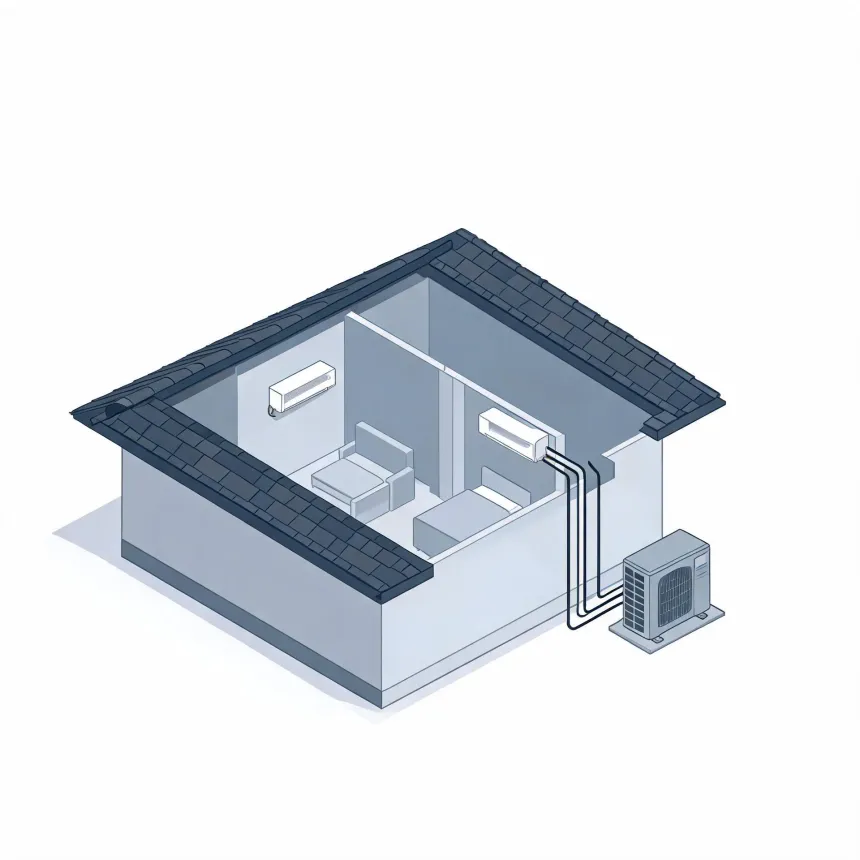
- A single outdoor unit can serve one room or several, depending on how many indoor heads are connected to it. A single-zone system covers one room with one indoor head. A multi-zone system ties several indoor heads to one outdoor unit, so each room gets its own thermostat and its own setting. How many zones one outdoor unit can carry depends on the unit itself, so a contractor will size it to the rooms you want covered.
- Can a mini split heat a whole house?
- Yes, a multi-zone mini split system can heat a whole house if it has enough indoor heads placed to cover it, one per room or per zone. Whether that makes sense for your house depends on the layout and how many zones you'd need. Winter nights here average 34°F, so the system has to be sized to keep up with that, not just handle mild days. A contractor can size the system to your house and tell you how many zones it would take.