
Ducts moving air the way they should
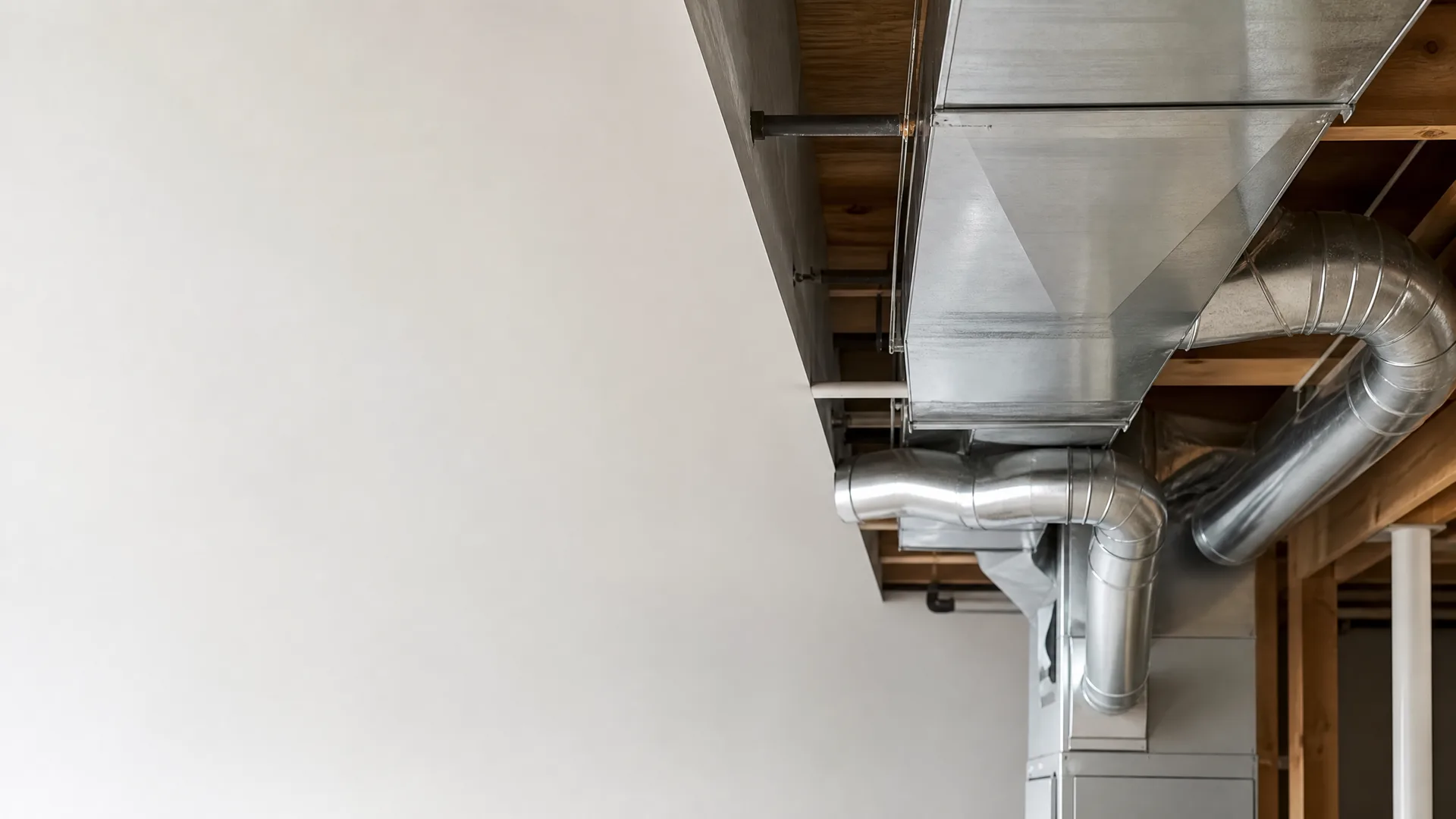
This is a clean, working duct system. Air moves through the metal and flex runs without picking up moisture along the way, and the joists and furnace stay dry. Nothing here feeds mold.
Skip searching for a duct system pro and answer a few questions instead.
Fill out one formMold inside air ducts usually shows up as a musty smell when the system kicks on, sometimes with dark specks around the vent covers. It grows there because ducts carry moisture along with air, and in Fulton County summers run long and sticky, which means the inside of a duct can stay damp for months at a stretch. Condensation that collects at the coil or in the ductwork near it gives mold the water it needs, and the system keeps pushing air across it every time it runs. Once mold takes hold inside the ducts, that smell and whatever is growing with it circulates through every room the system reaches, not just near the vent you noticed it at. It does not clear up by running the system more or less. The duct has to be cleaned, and whatever is keeping it wet, usually condensation that isn't draining the way it should, needs to be found and fixed, or the mold comes back.
Half the homes here were built by 1993
Half the homes in Fulton County were built in 1993 or earlier, so the ductwork behind your walls may be original and worth a look.
Heat runs November through April
Heat runs November through April here, and warm dry air alone won't clear out mold that's already growing in the ducts.
Cooling runs May through September
Cooling runs May through September, five humid months where the system keeps pulling moist air through the same ducts, feeding the mold each time it cycles on.
ACS 2020-2024 · NOAA nClimDiv 1991-2020

Mold around a vent cover or on the first foot of metal inside the duct is often within reach once the cover comes off. A contractor can wipe down and treat that section, check how far back the growth goes, and seal the cover back in place. If the smell clears up after that and doesn't return, the problem was likely limited to what you could already see.
When the musty smell is strong but you can't find any spots near the vents, the growth is probably further back in the ductwork or on the coil itself. That needs a camera run through the line or a look at the evaporator coil, which sits inside the air handler. Treating the visible part and leaving the rest does nothing. The smell comes back as soon as the system runs again.
You notice it most when the system first starts, a damp, closed-up smell that fades after a few minutes. Look at the vent covers themselves, especially in rooms you don't use much. Dark specks or a fuzzy gray film around the edges usually mean the growth has spread past what the cover hides. Some rooms may feel stuffier than others, or the air coming out feels heavier even when the temperature is right. If anyone in the house has started coughing more at home than away from it, or complains of a stuffy nose that clears up once they leave, the air moving through those ducts is worth a closer look. Left alone, mold in the ductwork keeps feeding on the moisture the system produces and spreads further into the metal with every cycle.

This is a clean, working duct system. Air moves through the metal and flex runs without picking up moisture along the way, and the joists and furnace stay dry. Nothing here feeds mold.

Here the ducts sit in the same tight space as cold water pipes and concrete walls that sweat in summer. That dampness settles on the metal and in the seams, and it doesn't dry out on its own.

It is April, and you have the windows cracked because the afternoon turned warm. The furnace clicks off for what might be the last time this year, and a minute later you notice it, that smell again, coming off the vent above the couch. You get up close this time. The grille is gray with dust, and so is the lamp shade a few feet away, and the top of the bookshelf. You wonder how long it has been doing that, and how many other rooms look the same once you start looking. You think about calling someone, then about the three or four calls that usually means, and you put it off again.
You already know the smell, and you've probably already looked up the vent covers once or twice to see how bad it is. Figuring out who actually deals with duct mold in Fulton County, calling two or three companies, and explaining the same musty smell and dark specks each time takes real effort on top of a problem you'd rather not think about. A contractor who works on ductwork in this area through every long, sticky summer knows what Fulton County houses this age tend to be hiding behind the walls, and what's usually causing the smell to keep coming back. Your request goes to one local contractor who can look at your situation directly, not a handful of companies competing for the job. That means fewer calls, less repeating yourself, and someone who already knows what they're walking into before they see your ducts.
A contractor can wipe down and treat the metal or flex runs, but duct cleaning doesn't change what's feeding the mold. If water is getting into the ducts from a leaky seam, a disconnected joint, or condensation dripping off a line, that moisture is still there after the cleaning is done. Mold needs a damp surface and something to feed on, and ductwork already has dust sitting inside it. Treating the duct without finding where the moisture is coming from means the same dark specks show up again in a season or two, usually in the same spots.
Ducts that stay dry inside don't grow mold, no matter how long the metal has been there. A tight seal at the joints keeps humid attic or crawlspace air from working its way in and condensing against cooler metal. That's the difference between a duct run that needs attention every couple of years and one that doesn't come up again. When a contractor seals a section after cleaning it, checking those seals is part of what keeps the fix from being temporary, especially where ductwork runs through a hot attic for most of the day.




If the moisture source is gone and the growth hasn't spread past the metal or flex runs, cleaning and sealing the ducts usually takes care of it in one visit.
Once growth gets past the ductwork and onto wood framing or into the furnace cabinet, cleaning the ducts alone won't stop it from coming back.



This is what a duct system looks like when moisture isn't collecting anywhere. The metal stays dry to the touch, the joists above it are clean, and the vapor barrier on the foundation walls is doing its job. Air moves through without picking up anything it shouldn't.

Bare concrete walls and floor mean any water that gets in has nowhere to drain and nothing to soak it up. Once the metal ducts above start holding moisture, the joists around them stay damp too, and that's the setup mold needs to keep coming back.
At 14.99 cents a kilowatt-hour, running a dehumidifier or an extra fan to dry out damp ducts doesn't cost much here. That makes it worth doing while a contractor works on the mold itself, instead of leaving the moisture to feed it again.
EIA-861 2025
A contractor inspects the vent covers and the first few feet of visible duct.
A camera or mirror checks how far back the growth runs inside the metal.
The contractor finds and points out where moisture is getting into the system.
Moldy sections get wiped down and treated with an antimicrobial solution.

The smell at startup, the specks around the vent cover, the growth that keeps coming back after you wipe it off: it all points to the same thing. Mold in your ducts needs moisture to keep going, and until that source gets fixed, cleaning the ducts only buys time. A contractor can tell you in one visit whether the growth is still confined to the metal or has reached the furnace and the joists, and what's letting water in.
You could spend an evening searching for who handles duct mold around Fulton County, then another one calling a few of them and describing the same smell and the same vent covers each time, then sitting with quotes that don't line up because nobody looked at the same thing. Request a contractor through this page instead and you're matched with one who works on ducts in this area and already knows what usually lets moisture in. One company, one visit to get an answer, instead of three conversations to get three different guesses.



No calling every shop in Fulton County
Your request stays with one local pro.